Elevating Digital Interfaces with Scalable Web Buttons Vector Design
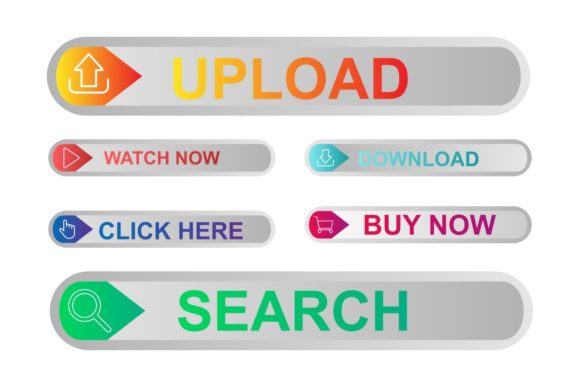
In the fast-paced ecosystem of modern web development and digital marketing, the smallest elements often carry the heaviest weight. A call-to-action button is not merely a shape on a screen; it is the gateway to conversion, the bridge between user intent and business outcome. This is where Web Buttons Vector Design transitions from a technical specification to a strategic asset. As screens multiply in size and resolution—from smartwatches to 4K monitors—the demand for graphics that remain crisp at any scale has never been higher. Relying on static pixel-based images is no longer sufficient for professionals who require flexibility, speed, and visual perfection across diverse platforms.
The shift toward vector-based assets represents a fundamental change in how creators approach interface design. Unlike raster images, which are composed of a fixed grid of pixels, vector graphics utilize mathematical paths. This distinction ensures that every curve, corner, and gradient remains sharp regardless of magnification. For entrepreneurs, freelancers, and in-house design teams, this means a single file can serve a mobile app icon, a website header, and a large-format print advertisement without ever losing quality. The efficiency gained here is substantial, eliminating the need to export multiple versions of the same asset for different resolutions.
The Evolution of Interface Assets in a Multi-Device World
Historically, web designers were constrained by bandwidth limitations and browser inconsistencies, often resorting to simple, low-resolution GIFs or JPEGs for interactive elements. Today, user expectations have shifted dramatically. Modern audiences expect seamless experiences that load instantly and look flawless on any device. This evolution has pushed Web Buttons Vector Design to the forefront of creative workflows. The ability to edit and resize files without degradation is no longer a luxury; it is a baseline requirement for maintaining brand integrity.
Consider the workflow of a marketing agency managing campaigns across social media, email newsletters, and corporate websites. In a raster-based workflow, a change in brand color or button shape requires reopening source files, re-exporting assets at various sizes, and replacing them across multiple content management systems. With vector files, specifically those compatible with industry-standard software like Adobe Illustrator or Corel Draw, these adjustments become trivial. A designer can modify the stroke weight or swap a hex code in seconds, and the update propagates seamlessly through the design system. This agility allows businesses to respond to market trends and A/B testing results with unprecedented speed.
Understanding the File Ecosystem: AI, SVG, CMX, and Beyond
To fully leverage the benefits of scalable graphics, one must understand the specific file formats included in a comprehensive design package. A robust collection typically provides a suite of formats to ensure compatibility across different stages of production. When you acquire a professional set of web buttons, you are not just getting an image; you are gaining access to a versatile toolkit.
- Vector AI: The native format for Adobe Illustrator, offering full layer access and editing capabilities for professional designers who need to customize every anchor point.
- Vector SVG: The standard for web implementation. SVG files are code-based, allowing them to be styled with CSS and animated with JavaScript, making them ideal for responsive web design.
- Vector CMX: A specialized format for Corel Draw users, ensuring that professionals working in this environment enjoy the same editing freedom as Illustrator users.
- Image PNG: Essential for immediate use in presentations, mockups, or platforms that do not support vector uploads, featuring transparency for clean integration.
- Image JPG: A universal fallback for broad compatibility, useful for email clients or older systems where vector support is limited.
This diversity in file types ensures that whether you are a developer integrating code directly or a blogger creating visuals for a post, the assets fit your specific technical needs. The inclusion of both editable vector sources and ready-to-use raster images bridges the gap between high-end customization and immediate deployment.
Practical Implications for Creators and Business Owners
For the independent creator or small business owner, the value of openable, editable, and resizable files extends beyond aesthetics—it is about resource management. Hiring a graphic designer for every minor tweak can quickly deplete a budget. By utilizing vector packs that allow for self-service customization, businesses maintain control over their visual identity. You can adapt a button's style to match a seasonal promotion or a specific landing page theme without external assistance.
Furthermore, the technical performance of vector graphics contributes directly to site speed and search engine optimization. SVG files, in particular, are often significantly smaller in file size compared to high-resolution PNGs, leading to faster load times. Since page speed is a known ranking factor for search engines, optimizing interface elements with vectors can indirectly boost organic visibility. This aligns with the broader trend of "green web design," where efficient coding and asset optimization reduce energy consumption and improve user experience.
Adapting to Modern Design Trends
Design trends are cyclical, yet the underlying need for scalability remains constant. Currently, we see a move towards minimalism, neumorphism, and bold, accessible typography within interface elements. Vector designs are uniquely suited to adapt to these shifts. Because the geometry is defined by math rather than pixels, applying a new shadow effect, rounding a corner to match a trendy "squircle" shape, or adjusting a gradient mesh is straightforward.
Professionals observing the market notice that brands are increasingly moving away from generic, stock-look interfaces. There is a premium on uniqueness. Having access to the source vectors allows a brand to take a standard button design and infuse it with proprietary brand elements—custom icons, specific border radii, or unique texture overlays. This level of customization helps distinguish a business in a crowded digital marketplace, fostering greater trust and recognition among users.
Workflow Integration and Future-Proofing
Integrating vector assets into a daily workflow requires a mindset shift from "finalized image" to "living component." When you download a package containing Vector AI, SVG, and CMX files, you are future-proofing your projects. Five years from now, when display technologies have advanced further, these files will still render perfectly. Pixel-based images from five years ago often look dated or blurry on new retina displays, requiring costly redesigns.
Moreover, the collaborative nature of modern projects benefits immensely from vector formats. In a team setting, a UX designer can hand off an SVG to a frontend developer, who can then manipulate the code directly without needing to ask for a new export. This reduces friction in the development cycle and minimizes errors caused by miscommunication or version control issues. The clarity of vector paths ensures that what is designed is exactly what is built.
Ultimately, the choice to utilize high-quality vector designs is a commitment to professionalism and longevity. It acknowledges that digital products are not static; they evolve, expand, and migrate across platforms. By starting with assets that are inherently flexible, creators save time, reduce technical debt, and ensure their visual communications remain impactful regardless of where they appear. Whether you are refining a checkout flow for an e-commerce store or crafting a portfolio for a creative agency, the precision and adaptability of vector graphics provide the foundation for success.
As you incorporate these resources into your projects, remember that the true power lies in the editability. Do not hesitate to open those AI or CMX files and experiment. Change the colors to test conversion rates, resize the elements for a new ad campaign, or combine shapes to create something entirely new. The tools are there to empower your creativity, ensuring that your digital presence is as dynamic and resilient as the market itself. Thanks for downloading and taking the step toward a more scalable, efficient, and visually stunning digital workflow.